
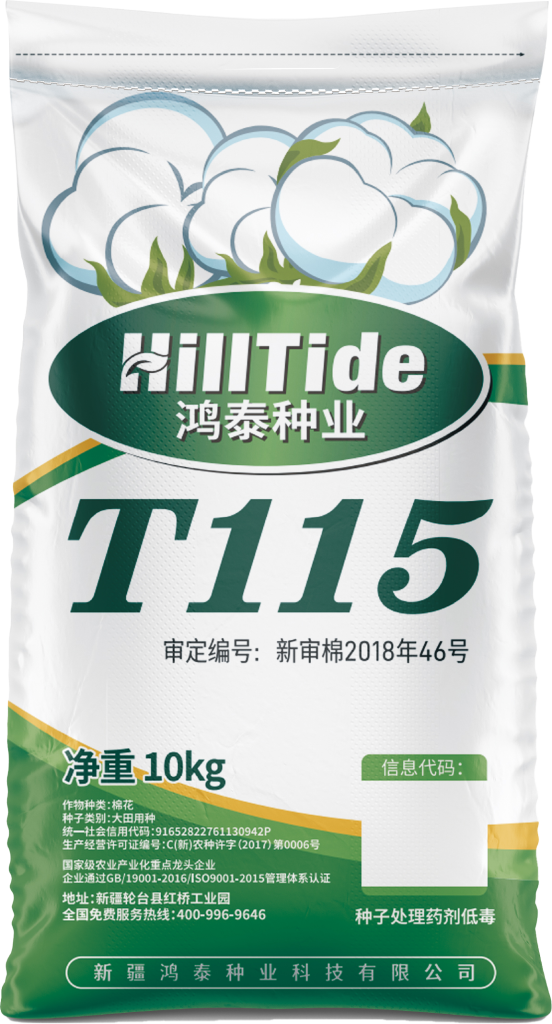
This is an insect-resistant, salt-alkali tolerant,
high-yield and high-quality conventional cotton variety.
This variety has a growth period of approximately 120 days and a plant height of 90‑100 cm. It features a tower‑shaped plant architecture with Type‑II fruiting branches; the first fruiting‑branch node is at node 6.2. It has robust stems, dark‑green, duck‑foot‑shaped, medium‑small leaves and good plant uniformity. It exhibits strong growth vigor with upward‑angled fruiting branches for excellent ventilation and light penetration.
It has wide adaptability and relatively strong disease resistance: resistant to Fusarium wilt and tolerant to Verticillium wilt. Boll‑setting is strong and concentrated. The bolls are elliptical, large with thin boll walls, showing full, smooth and concentrated boll opening. The lint is plump and snow‑white with good lint‑holding performance, and the variety has favorable early‑maturity characteristics.
The average single‑boll weight is about 5.7 g, and the saw‑ginning outturn is 45.2%. It boasts good cotton fiber quality. Tested by the Ministry of Agriculture Testing Center, the average fiber length of middle‑upper bolls is 29.5 mm, breaking tenacity is 31.4 cN/tex, micronaire value is 4.4, uniformity index is 85.6%, and elongation rate is 6.7%.
●Salt‑alkali tolerance and bollworm resistance
●Good lint‑holding capacity, strong stalk lodging resistance and suitable for mechanical harvesting.
●It possesses excellent boll‑setting ability, with abundant double‑boll and triple‑boll formations. Each boll locule mostly contains ten seeds
●Drought tolerance and high‑temperature tolerance
●It has neat plant architecture with good ventilation and light penetration.
●Resistant to Fusarium wilt, tolerant to Verticillium wilt, with high ginning outturn.
● Timely sowing:Generally sown in early to mid-April. The suitable sowing date is when the soil temperature at 5 cm depth steadily exceeds 14°C.
●Rational close planting:Seeding density 210,000-240,000 plants/ha; harvest density 180,000-210,000 plants/ha. The optimal pattern is 3 rows per 2.05 m mulch film with 22-24 holes per meter.
●Water and fertilizer management:For drip-irrigated cotton, irrigate every 7-10 days according to soil moisture, with a water application rate of 300-525 m’/ha per time. Shorten irrigation intervals during high-temperature periods.
●Rational chemical regulation:Implement full-season chemical regulation with early, light and frequent applications. Apply mepiquat chloride at 90-120 g/ha 5-7 days after topping, and reapply at 150-225 g/ha after another 5-7 days.
●Pest control:Timely control aphids, thrips, red spiders, mirids and other pests.
●Notes:Not suitable for planting in severely diseased fields. In moderately and lightly diseased fields, apply Bacillus subtilis through drip inigation during the Ist to 3rd irrigations.